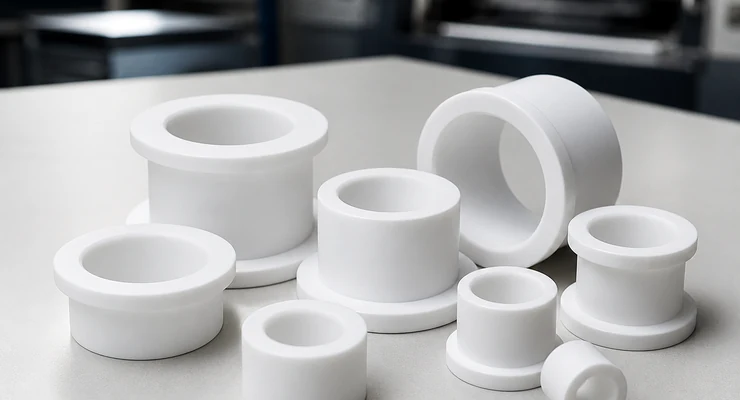
In short: a PTFE nozzle bush for a Glass Lined Reactor (GLR) must combine near-universal chemical resistance, tight dimensional tolerances, thermal stability from −200°C to +260°C and reliable creep resistance — because the nozzle is the most failure-prone zone of the vessel and the bush is what protects the glass lining at that interface.
Introduction: why nozzle bush selection impacts GLR performance
In Glass Lined Reactor maintenance, nozzle areas are among the most failure-prone zones due to mechanical stress, chemical exposure and thermal cycling. Every branch, agitator entry and outlet nozzle concentrates load and media attack into a small area of the lining, so the components installed there carry a disproportionate share of the reliability risk.
Selecting the right PTFE nozzle and collar bush is critical to ensure leak prevention, glass lining protection and long-term sealing reliability. Get it wrong and the failure rarely stays local — a chipped lining or a relaxed seal at one nozzle can take the whole reactor out of service.
Key requirements for PTFE nozzle bush in GLR systems
| Requirement | Importance |
|---|---|
| Chemical compatibility | Resists acids, solvents and corrosive chemicals |
| Dimensional precision | Protects glass lining and ensures fitment |
| Thermal stability | Operates from −200°C to +260°C |
| Mechanical integrity | Handles compression loads and pressure |
Chemical compatibility
PTFE offers near-universal resistance to acids, solvents and aggressive media, making it ideal for GLR environments. Unlike elastomers or coated metals, it does not swell, extract or degrade in contact with the process fluid, so the bush is not itself a contamination or corrosion source. This is why PTFE — rather than rubber or metal — is the near-universal specification for glass-lined vessel connections.
Dimensional precision
Accurate tolerances ensure proper fitment and prevent stress on glass-lined surfaces. A bush that is oversized, undersized or out-of-round loads the glass unevenly, and glass has almost no tolerance for point loading. Precision machining to the nozzle’s actual dimensions keeps the contact stress distributed and predictable.
Thermal stability
PTFE performs reliably across a wide operating temperature range, holding its properties through the heating and cooling cycles that GLRs routinely see in batch processing. It will not embrittle at low temperature or soften into failure at the top of its range, so the seal stays intact across thermal cycling.
Mechanical integrity
High-quality PTFE bushes resist creep and maintain sealing performance under sustained bolt and process load. For higher-load joints, glass-filled or carbon-filled grades add creep resistance and dimensional stability while keeping PTFE’s chemical resistance — the same grade logic covered in our PTFE bushes industrial guide.
Common failure risks
- Glass lining damage at the nozzle interface
- Leakage due to improper sealing
- Frequent maintenance shutdowns
- Increased lifecycle cost
Almost all of these trace back to two root causes: the wrong PTFE grade for the load, or dimensional inaccuracy that concentrates stress on the glass. Both are avoidable at the specification and inspection stage — which is where maintenance teams have the most leverage.
Best practices for GLR maintenance teams
- Verify material grade (virgin vs filled PTFE) against a material certificate
- Check machining precision and surface finish before acceptance
- Ensure flange and bore compatibility with the actual nozzle
- Inspect for scratches and defects, and validate fitment before installation
- Re-torque bolted joints after the first thermal cycle to counter PTFE relaxation
For the deeper quality-control view — surface finish, purity and the inspection checklist — see our companion guide on PTFE nozzle bush quality for glass-lined vessels. For the wider role these components play in rotating and sealing duty, see PTFE bushes in pumps, valves & agitators.
Conclusion
In 2026, GLR reliability depends heavily on component-level precision. PTFE nozzle bushes are critical engineered components that directly affect sealing performance, equipment protection and long-term reliability — treat them as a specified engineering item, not a commodity spare.
Need precision PTFE nozzle bushes? Contact our engineering team for custom-engineered PTFE nozzle bushes for glass-lined reactors and vessels.

Fluoro Polymer Products — Engineering Team
ISO 9001:2015 certified PTFE manufacturer in Anand, Gujarat with 25+ years of hands-on experience engineering fluoropolymer components for chemical, pharma, food and power industries since 1997.