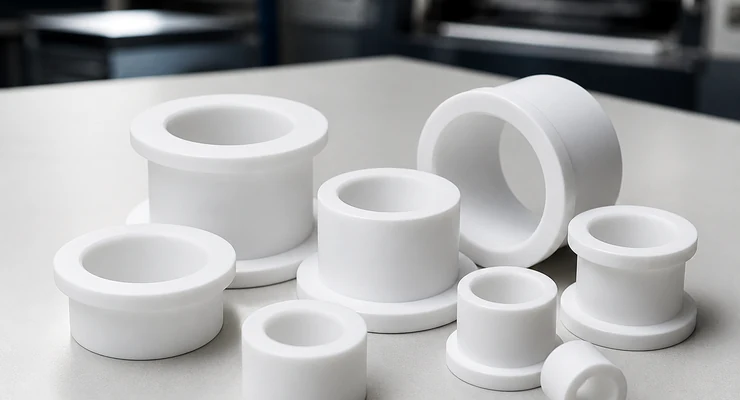
In short: before fitting a PTFE nozzle bush to a glass-lined vessel, check four things — surface finish, material purity, dimensional accuracy and creep resistance. Each one directly determines whether the bush protects the glass lining or slowly damages it.
Introduction: protecting glass lining starts at the interface
Glass-lined vessels are widely used in chemical processing because of their corrosion resistance. However, the weakest point is often the nozzle interface, where mechanical load, sealing force and chemical attack all meet the edge of the glass.
The quality of the PTFE nozzle bushing directly affects the integrity of the glass lining. Poor-quality components create stress concentrations, compromise sealing performance and increase maintenance costs — which is why quality inspection, not just material choice, matters at this interface.
Critical quality parameters for PTFE nozzle bushes
| Quality parameter | Importance |
|---|---|
| Surface finish | Prevents micro-abrasion and protects delicate glass lining |
| Material purity | Ensures maximum chemical resistance and long service life |
| Dimensional accuracy | Maintains proper fitment and load distribution |
| Creep resistance | Prevents deformation under sustained compression |
Surface finish
Smooth machined surfaces help prevent damage to glass-lined vessel interfaces and improve sealing reliability. Any roughness, scoring or tool chatter on the contact face becomes an abrasion point against the glass and a leak path across the seal, so surface finish is one of the first things to inspect and one of the easiest to get wrong with rushed machining.
Material purity
Virgin PTFE offers superior chemical resistance and is the default choice for high-purity and aggressive-media duty. Filled PTFE provides higher strength and better creep resistance, but the fillers must be uniformly distributed — poorly blended filled stock creates weak spots and inconsistent chemical resistance. Always confirm the grade against a material certificate rather than by appearance.
Dimensional accuracy
Improper tolerances create uneven load distribution and increase the risk of glass damage. Glass tolerates distributed pressure but not point loading, so an out-of-round or mis-sized bush concentrates stress exactly where the lining is most vulnerable. Precision machining to the vessel’s real nozzle dimensions is what keeps contact stress predictable.
Creep resistance
High-quality PTFE nozzle bushes should maintain dimensional stability under continuous compression loads. Because the bush sits permanently under bolt and process load, a grade with poor creep behaviour will cold-flow over time, relax the seal and eventually leak. Filled PTFE grades hold their dimensions better under sustained load.
Why quality matters
The cost of a low-quality nozzle bush is rarely the bush itself — it is what fails around it:
- Glass chipping or cracking
- Seal failure
- Chemical leakage
- Unexpected downtime
- Expensive vessel repairs
Inspection checklist
| Inspection item | Verification |
|---|---|
| Visual inspection | Check for scratches and defects |
| Dimensional verification | Confirm critical tolerances |
| Material certification | Verify PTFE grade |
| Fitment validation | Ensure compatibility before installation |
These checks take minutes and prevent the failure modes above. For the maintenance-planning view — requirements, failure risks and best practice for reactor teams — see our companion guide on PTFE nozzle bush requirements for GLR maintenance.
Conclusion
For glass-lined systems, component quality directly impacts asset life. Selecting high-quality PTFE nozzle bushes helps protect equipment, reduce downtime and improve long-term reliability.
Fluoro Polymer Products provides high-precision PTFE nozzle bushes engineered to protect glass-lined vessels under demanding process conditions. Talk to our engineering team for a grade and tolerance recommendation for your vessel.

Fluoro Polymer Products — Engineering Team
ISO 9001:2015 certified PTFE manufacturer in Anand, Gujarat with 25+ years of hands-on experience engineering fluoropolymer components for chemical, pharma, food and power industries since 1997.