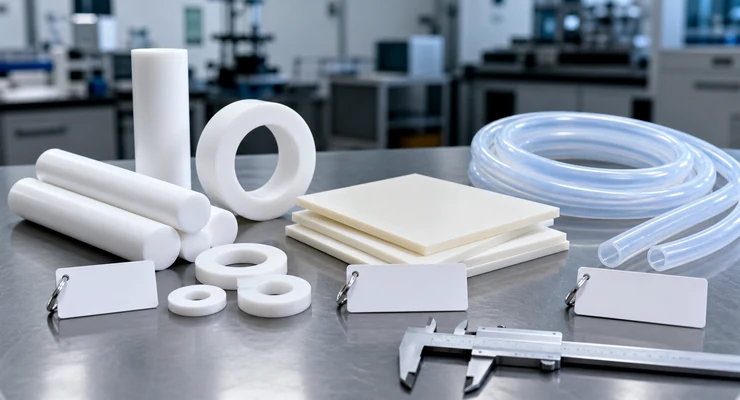
PTFE, PVDF and PFA are three of the most widely used fluoropolymers in industrial sealing and process equipment. They look similar on a datasheet, but choosing the wrong one leads to premature failure, leaks or unnecessary cost. This guide compares them on the factors that actually drive a material decision — temperature, chemical resistance, mechanical strength, manufacturability and cost — and gives a clear recommendation for each scenario.
PTFE vs PVDF vs PFA — at a glance
| Property | PTFE | PVDF | PFA |
|---|---|---|---|
| Max continuous temp | ~260°C (highest) | ~140°C | ~260°C |
| Chemical resistance | Near-universal | Broad (weak vs strong bases / amines) | Near-universal |
| Coefficient of friction | Lowest of any solid | Low–moderate | Very low |
| Mechanical strength / rigidity | Soft, cold-flows under load | Strongest, rigid | Soft (similar to PTFE) |
| Manufacturing | Moulded & machined (not melt-flow) | Melt-processable, weldable | Melt-processable, seamless parts |
| Relative cost | Moderate | Lowest | Highest |
| FDA / food-grade options | Yes | Yes | Yes |
General guidance for material selection; confirm exact ratings against the grade datasheet for your operating pressure and media. Figures as of 2026.
When to choose PTFE
Choose PTFE when chemical resistance, temperature or low friction are the priority. It handles almost any acid, base or solvent up to ~260°C and has the lowest friction of any solid, which is why it dominates gaskets, bushes, valve seats and bellows. Its main limitation is mechanical: it is soft and cold-flows under sustained load, so use filled grades (glass, carbon, bronze) where structural strength matters. See our PTFE gaskets, PTFE bushes and PTFE bellows.
When to choose PVDF
Choose PVDF when you need higher mechanical strength, rigidity and weldability at moderate temperatures (up to ~140°C), or to reduce material cost. It is excellent for piping, tanks and fabricated structures handling many chemicals — but verify compatibility, as strong bases, amines and some ketones can attack it. Where the medium is that aggressive, step up to PTFE or PFA.
When to choose PFA
Choose PFA when you need PTFE-level chemical resistance and temperature plus the ability to melt-process complex, seamless, void-free parts — common in ultra-high-purity linings, tubing and semiconductor or pharmaceutical applications. The trade-off is higher cost.
Quick verdict
- Maximum chemical resistance / temperature / low friction → PTFE (filled grades for load).
- Strength, rigidity, weldability, lower cost at moderate temps → PVDF.
- PTFE chemistry + complex seamless/high-purity parts → PFA.
Not sure which grade fits your process? Talk to our engineering team or download the brochure for full grade and dimension data — we manufacture custom PTFE components to your exact specification.

Fluoro Polymer Products — Engineering Team
ISO 9001:2015 certified PTFE manufacturer in Anand, Gujarat with 25+ years of hands-on experience engineering fluoropolymer components for chemical, pharma, food and power industries since 1997.