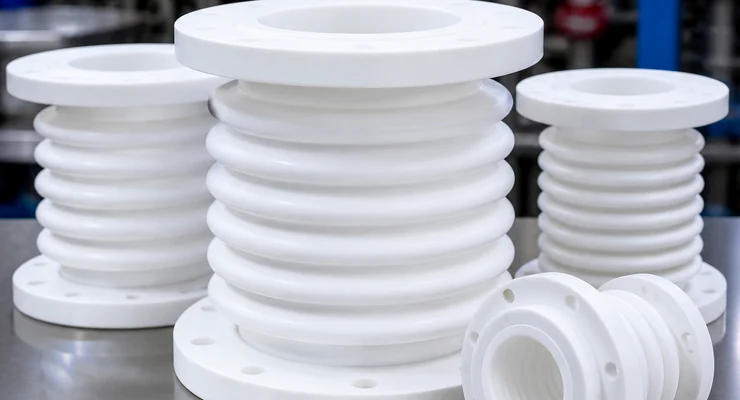
Every industrial pipeline system that handles fluids at elevated temperatures, or that is connected to rotating or vibrating equipment, experiences movement. Thermal expansion and contraction. Pump and compressor vibration. Equipment misalignment introduced during installation. All of this movement must go somewhere — and in aggressive chemical service, the only flexible connector that provides both the required flexibility and complete chemical resistance is a PTFE bellows.
How to specify PTFE bellows — engineering parameters checklist
| Parameter | What to define | Why it matters |
|---|---|---|
| Bore diameter (DN) | Internal diameter matching pipe schedule | Determines material cross-section and flow area |
| Face-to-face length | Overall installed length | Must fit within available installation space |
| Pressure rating | Maximum operating pressure | Determines wall thickness and reinforcement need |
| Temperature range | Min and max operating temperature | Confirms PTFE grade suitability |
| Movement required | Axial, lateral, angular — mm and degrees | Determines number of convolutions and geometry |
| Flange specification | ANSI, DIN, BS or custom | Must match connecting pipeline flanges |
| PTFE grade | Virgin, glass-filled, carbon-filled | Based on chemical environment and pressure |
| Chemical service | Process fluid identity and concentration | Confirms PTFE compatibility |
Fluoro Polymer Products, established 1997, ISO 9001:2015 certified (TUV Nord), manufactures precision PTFE bellows and expansion joints from Anand, Gujarat — supplying chemical plants, pharmaceutical manufacturers, and industrial process facilities across India, the EU, GCC, USA and Canada.
What is a PTFE bellows and how does it work?
A PTFE bellows is a flexible, corrugated (convoluted) tubular component manufactured from PTFE, installed in a pipeline to absorb movement, vibration and misalignment while maintaining continuous, chemically resistant fluid containment. The corrugated geometry — the series of alternating peaks and valleys — provides the flexibility. Each convolution flexes as the pipeline moves. The total movement capacity depends on the number of convolutions, the convolution geometry and the PTFE wall thickness. PTFE bellows are typically manufactured with integral flanges to match connecting pipeline flanges for direct installation.
Types of PTFE bellows available
- Convoluted PTFE bellows (standard) — the most widely used design, with multiple full convolutions along the active length. Provides balanced axial (10–25 mm), lateral (5–20 mm) and angular (3–8°) movement capacity. The default specification for most chemical and pharmaceutical piping applications.
- Single-convolution PTFE bellows (compact) — specified where installation space is limited, giving minimal length with sufficient movement capacity for the application.
- Reinforced PTFE bellows — with external stainless steel mesh or ring reinforcement for higher-pressure applications, constraining the PTFE from pressure-induced blowout while retaining flexibility and chemical resistance.
- PTFE expansion joints (multi-ply or thick-wall) — higher pressure ratings and larger movement capacities for demanding process applications.
- Custom PTFE bellows — manufactured to customer drawings, with non-standard bore sizes, flange configurations and special materials, including integral tie rods and limit stops where required.
Key applications by industry
- Chemical industry: pump suction/discharge connections (vibration isolation), heat exchanger connections (thermal movement), reactor inlet/outlet connections and acid-handling pipelines — wherever pipe movement accommodation is required in corrosive service.
- Pharmaceutical industry: in addition to chemical resistance, PTFE bellows are FDA / USP Class VI compliant — non-contaminating in API manufacturing, formulation facilities and sterile filling lines.
- Glass-lined reactor connections: PTFE bellows absorb movement without transmitting forces that could damage the fragile glass lining — the standard specification for glass-lined reactor pipe connections, alongside precision PTFE nozzle and collar bushes at the vessel nozzles.
- Fluorine gas and HF acid applications: PTFE is one of the few materials with genuine resistance to HF and fluorine gas, making PTFE bellows the specified flexible connector in these uniquely aggressive piping systems.
- Power plant applications: cooling water piping, chemical dosing systems and FGD systems — where chemical resistance and thermal flexibility are both required.
PTFE bellows vs rubber expansion joints — which do you need?
| Factor | Rubber expansion joints | PTFE bellows |
|---|---|---|
| Chemical resistance | Limited — depends on rubber type | Virtually universal |
| Temperature range | −40°C to +120°C (Viton to +200°C) | −200°C to +260°C |
| Movement capacity | Very good (inherently flexible) | Good (per convolution count) |
| Pharma / food compliance | Not generally appropriate | FDA / USP Class VI |
| Service life in chemical duty | Moderate — chemical attack is the primary failure mode | Long — chemical attack is not a failure mechanism |
| Cost | Lower initial cost | Higher initial, lower lifecycle cost in chemical duty |
For the applications, advantages and material-grade fundamentals behind these choices, see our PTFE bellows guide. Not sure which grade fits your process? Talk to our engineering team or download the brochure for full grade and dimension data — we manufacture custom PTFE bellows to your exact specification.

Fluoro Polymer Products — Engineering Team
ISO 9001:2015 certified PTFE manufacturer in Anand, Gujarat with 25+ years of hands-on experience engineering fluoropolymer components for chemical, pharma, food and power industries since 1997.