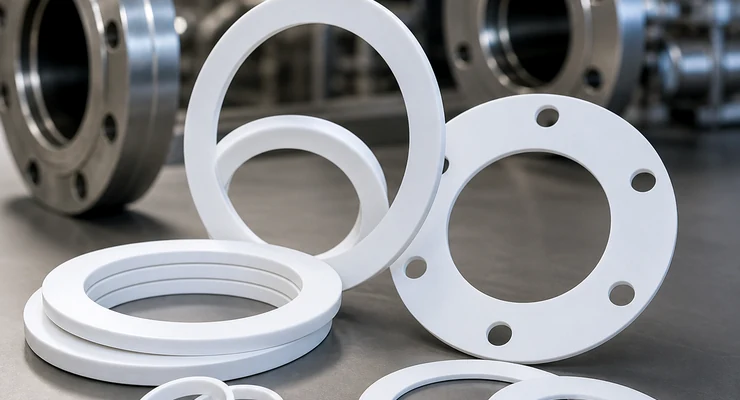
PTFE (polytetrafluoroethylene) gaskets are among the most versatile sealing solutions in modern industry. Their unique combination of near-universal chemical resistance, a wide temperature range and a low-friction, non-stick surface makes them the default choice for engineers sealing aggressive media. This guide walks through the key properties, common applications and installation best practices for leak-free sealing.
Why choose PTFE gaskets?
PTFE is chemically inert to almost all industrial chemicals, acids and solvents. It performs reliably from cryogenic temperatures up to around 260°C, does not age or embrittle like elastomers, and is FDA-compliant for food and pharmaceutical contact. These qualities make PTFE gaskets ideal where contamination, corrosion or temperature cycling would defeat conventional materials.
Available grades
- Virgin PTFE — maximum chemical purity and resistance, best for food, pharma and ultra-pure applications.
- Glass-filled PTFE — improved creep resistance and dimensional stability under load.
- Carbon-filled PTFE — enhanced wear resistance and thermal conductivity for dynamic sealing.
- Expanded PTFE (ePTFE) — highly conformable, excellent for uneven or glass-lined flanges.
Installation best practices
- Clean and inspect flange faces for scoring, pitting or debris.
- Select the correct gasket thickness and grade for the service conditions.
- Lubricate bolt threads and use new, correctly rated fasteners.
- Tighten bolts in a star (criss-cross) pattern in incremental passes to seat the gasket evenly.
- Re-torque after the first thermal cycle, as PTFE can cold-flow and relax slightly under load.
Avoiding common failures
Most PTFE gasket failures trace back to over-compression, uneven bolt loading or choosing virgin PTFE where a filled grade was needed to resist creep. Matching the grade to the load and following a disciplined torque sequence eliminates the large majority of leaks.
Need help specifying the right PTFE gasket for your flanges? Download our brochure for full grade and dimension data, or contact our engineering team for a recommendation.

Fluoro Polymer Products — Engineering Team
ISO 9001:2015 certified PTFE manufacturer in Anand, Gujarat with 25+ years of hands-on experience engineering fluoropolymer components for chemical, pharma, food and power industries since 1997.